Egress Window Cost Calculator
- 2026 contractor pricing
- Poured, block and framed walls
- Built-in code checklist
How much does an egress window cost?
Adding a basement egress window typically costs $3,000 to $6,500, and most homeowners pay around $4,500–$5,500 for a new opening in a poured concrete wall. The price covers far more than the window itself: digging the well, cutting through the foundation, installing the well, drainage and finishing the inside. If the opening and well already meet code, simply replacing the window runs about $1,000–$1,500.
Here’s what the calculator returns at average U.S. prices for one casement window with a standard steel well, cover, interior trim and permit:
| Job | Estimated cost |
|---|---|
| Replace the window only (opening and well already meet code) | $1,300 |
| Walkout or above-grade framed wall, 2 ft deep | $3,930 |
| Enlarge an existing window in poured concrete | $4,640 |
| New opening in poured concrete, 4 ft deep | $5,060 |
| New opening in a concrete block wall | $5,260 |
| Premium: composite well, drain, heavy cover, fiberglass window, 5 ft deep | $8,370 |
Where the money goes
| Item | Typical price |
|---|---|
| Excavation, gravel & backfill | $800–$1,500 |
| Cutting a poured concrete wall | $1,000–$2,000 |
| Cutting a block wall and adding a lintel | $1,200–$2,000 |
| Egress window, installed | $700–$1,500 |
| Galvanized steel window well | $500–$900 |
| Composite well with molded steps | $1,300–$2,000 |
| Terraced stone or timber well | $3,000+ |
| Well cover | $250–$550 |
| Well drain | $500–$700 |
| Interior drywall return & trim | $400–$600 |
| Permit | $150–$400 |
Egress window requirements
Most U.S. building codes follow section R310 of the International Residential Code. It requires an emergency escape opening in every basement bedroom, and in basements with habitable space. The key rules:
- Net clear opening of at least 5.7 sq ft (5.0 sq ft for ground-floor openings). This is the actual open area when the window is fully open, not the size of the frame.
- At least 24 inches high and 20 inches wide when open. You need both minimums and the total area.
- Sill no more than 44 inches above the floor.
- Opens from the inside without keys, tools or special knowledge.
- Window well at least 9 sq ft, extending at least 36 inches out from the wall.
- A permanent ladder or steps if the well is deeper than 44 inches.
Local codes can add to these, so confirm with your building department before you order a window. For other basement code rules, see our guide to basement code violations that cost homeowners thousands.
Casement vs. sliding egress windows
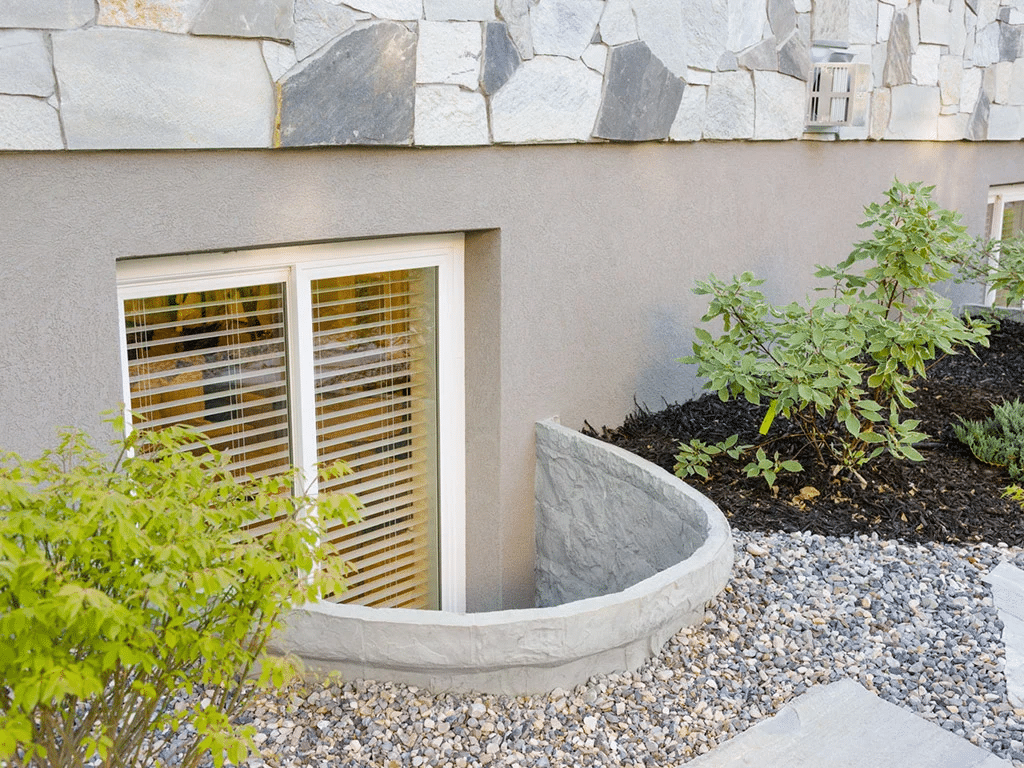
Casement windows crank open on a side hinge, so nearly the whole frame becomes open space. That lets them meet the 5.7 sq ft rule with the smallest possible hole in the foundation, which often saves more in cutting than the window costs. Sliding windows are cheaper, but only half the frame opens, so they need a much wider opening to pass. Single- and double-hung windows rarely work in basements for the same reason.
Choosing a window well
- Galvanized steel: the most common and least expensive. Deeper wells need a separate ladder.
- Composite or polymer: molded wells with built-in steps and a stone-look finish. They cost more, but look better and let in more light.
- Terraced stone or timber: landscaped steps that double as an escape route. They’re the most attractive and the most expensive.
Whichever you choose, add gravel at the bottom and, ideally, a drain to the footing drain tile or a dry well. A clear cover keeps out leaves, snow and small animals, but it must be easy to push open from below.
DIY or hire a pro?
Most homeowners hire this out. Cutting a foundation requires a large diamond saw, lots of water control and knowing where to cut. Mistakes can crack the wall or undermine a structural opening. Block walls need a lintel to carry the load above. The part a handy homeowner can realistically take on is digging the well, which the calculator lets you tick to see the savings. Call 811 to locate buried utilities before you dig.
Is an egress window worth it?
If you want a basement bedroom, it’s not optional. Without code-compliant egress, the room can’t legally be called a bedroom, which limits its value when you sell and can create insurance and liability problems if someone sleeps there. Beyond compliance, a large egress window transforms a basement with natural light and fresh air, making it feel like part of the house. Planning a guest suite or rental? Pair this with our basement bathroom cost calculator and the full basement finishing cost calculator.
Related guides
- Basement finishing cost calculator
- Basement bathroom cost calculator
- Basement code violations to avoid
- Converting a basement into an apartment
Frequently asked questions
How much does it cost to put an egress window in a basement?
Usually $3,000 to $6,500. A new opening in a poured concrete wall with a standard steel well runs about $5,000 at average prices. Composite or landscaped wells, deep wells, drainage and patios in the way push costs higher.
What size does an egress window have to be?
Under the International Residential Code, the open area must be at least 5.7 sq ft, with a clear opening at least 24 inches high and 20 inches wide, and a sill no more than 44 inches above the floor. Local codes may add requirements.
Does every basement need an egress window?
Every basement bedroom needs its own emergency escape opening, either an egress window or an exterior door. Many codes also require at least one egress opening when a basement is finished into habitable space, even without a bedroom. Check your local requirements.
Do I need a permit for an egress window?
Almost always. Cutting a foundation is structural work, and the inspector will verify the opening size, sill height and window well. Permits typically cost $150 to $400.
How long does it take to install an egress window?
A professional crew usually finishes in one to two days: digging and cutting on the first day, then setting the window, well and backfill. Add time for permit approval and any interior finishing.
Pingback: Basement Finishing Checklist: 12 Steps in the Right Order - Basement Calculator