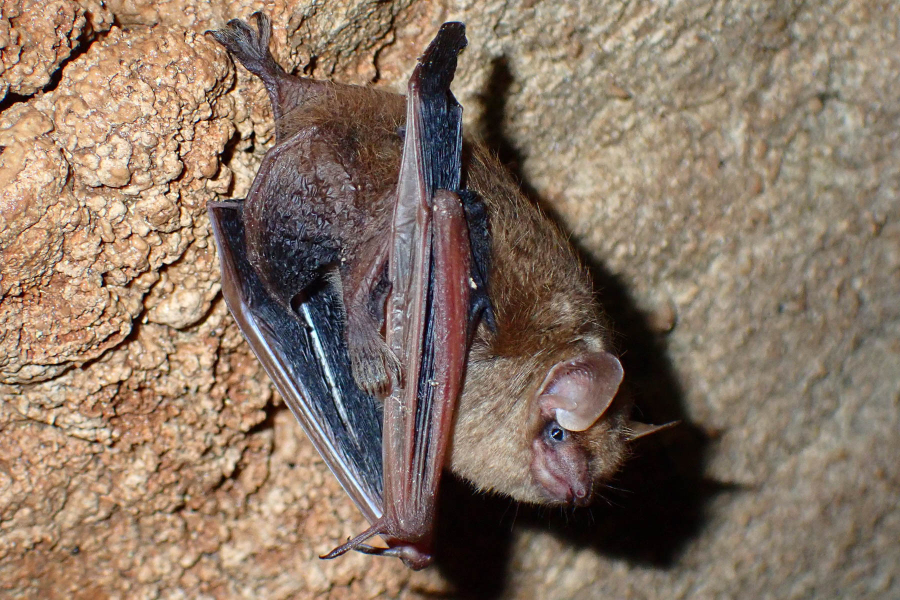
You finally finished the basement. New drywall, a dehumidifier humming in the corner, maybe a little home theater setup where the old storage shelves used to be. Then one evening you hear a faint scratching near the rim joist, or you spot a dark smear of droppings along the foundation wall where it meets the subfloor. A bat has found its way into the one part of the house you just spent thousands of dollars upgrading. If you own a finished or semi-finished basement, this scenario is more common than people assume, and it raises a fair question before you do anything else.
The short answer is that bats themselves are not aggressive, but they can carry real health risks that homeowners shouldn’t brush off. A single bat roosting behind insulation or squeezed into a gap near your sill plate can expose a household to rabies, histoplasmosis from accumulated droppings, and the stress of trying to safely remove a wild animal from a finished living space. Pest control professionals who cover this in detail, including a thorough breakdown of whether are bats dangerous to humans, generally agree that the danger isn’t a bat swooping at your head, it’s the quieter risks that build up when one goes unnoticed in a basement for weeks. That distinction matters a lot once you start thinking about how bats actually get into finished spaces in the first place.
Why bats end up in basements and finished homes
Bats aren’t looking for your basement specifically, they’re looking for a dark, temperature-stable gap that mimics a cave or hollow tree. Unfinished rim joists, gaps around utility penetrations, and loose window well covers all qualify. Once a basement gets finished, those same gaps don’t disappear, they just get covered with drywall or framing, which actually makes a roosting bat harder to notice until the smell or the noise gives it away. Older homes with masonry foundations are especially prone to this because mortar joints shrink and crack over decades, leaving quarter-inch openings that a bat can flatten its body through without much effort.
Seasonal timing plays a role too. Bats look for winter hibernation spots in fall and maternity roosts in late spring, so basements see two predictable waves of activity each year. A finished basement with a walkout door or an egress window well is particularly vulnerable if the weatherstripping has worn thin, since that’s one of the few direct paths from outside grade into conditioned living space. Homeowners who treat their basement as “done” after finishing it often stop checking these entry points annually, which is exactly when a colony can establish itself unnoticed.
The real health risks bats pose to people
Rabies is the headline concern, and for good reason. According to CDC, bats are the leading wildlife source of rabies exposure, accounting for about 35% of reported cases, even though robust prevention efforts keep annual U.S. deaths in the single digits. The risk isn’t theoretical for basement owners specifically, since bats that get trapped indoors are more likely to end up in direct contact with sleeping household members or curious pets than bats encountered outdoors. A bite can be so small it goes unnoticed, which is why health officials recommend treating any direct contact with a bat in a living space as a potential exposure rather than waiting for a visible wound.
Beyond rabies, long-term bat roosts leave behind guano that can harbor the fungus responsible for histoplasmosis, a respiratory illness that spreads when dried droppings are disturbed and inhaled. This is a particular concern in basements because they’re enclosed and often poorly ventilated compared to an attic, so spores can concentrate in the air during cleanup. The table below puts some of the broader national numbers in context, showing how often rabies exposure actually prompts medical attention versus how rarely it proves fatal thanks to prompt treatment.
| Metric | Figure |
|---|---|
| Americans seeking care for possible rabies exposure annually | About 1.4 million |
| Share of wildlife rabies exposures from bats | Roughly 35% |
| People receiving post-exposure prophylaxis shots annually | Around 100,000 |
| Annual U.S. rabies deaths | Fewer than 10 |
| Rise in CDC rabies inquiries, summer 2026 vs. summer 2025 | 17% increase |
How moisture and basement gaps invite bats in
Bats are drawn to the same conditions that cause basement problems in general: cracks, gaps, and humidity. A damp basement with a musty smell often has the foundation cracks or poor grading that also let insects in, and insects are exactly what bats come looking for. If your basement already struggles with seasonal dampness, you’re unintentionally running an open invitation for both bats and the moisture-loving pests they eat. This overlap is why pest issues and water intrusion issues tend to show up together rather than as separate problems.
Fixing the moisture side of this equation does double duty, since sealing foundation cracks and improving drainage closes off bat entry points while also protecting your finished walls and flooring from water damage. Homeowners weighing how far to take this kind of project often start by looking at basement waterproofing cost to understand what full crack sealing, interior drainage, and sump pump upgrades might run before committing. It’s a reasonable first step, because a waterproofed basement with sealed foundation joints is inherently less hospitable to bats, rodents, and the insects that draw them in. Think of it less as a pest project and more as a structural one that happens to solve your bat problem as a side effect.
Sealing, drying out, and pest-proofing your basement for good
Once moisture is under control, the next step is a careful exterior inspection looking for gaps larger than a quarter inch around the foundation, window wells, utility penetrations, and the rim joist area. Caulk, steel wool, and hardware cloth handle most small openings, while larger gaps around pipes or vents may need expanding foam backed by a rigid cover so bats can’t chew or push through it. Timing matters here too, since sealing entry points while bats are still inside traps them in the basement, so most professionals recommend installing one-way exclusion devices first and sealing permanently only after you’re confident the space is empty.
A finished basement benefits from a simple annual check built into your regular home maintenance, the same way you’d check gutters or HVAC filters. Walk the exterior foundation line each fall before bats start looking for winter roosts, and again in spring before maternity season begins. Pair that with keeping the basement dry year-round using a dehumidifier and a working sump pump, since dry, well-sealed basements simply aren’t attractive to bats looking for a damp, dark hiding spot. Handled this way, the finished basement you worked hard to build stays what it was meant to be, a comfortable extension of your home rather than an accidental wildlife shelter.